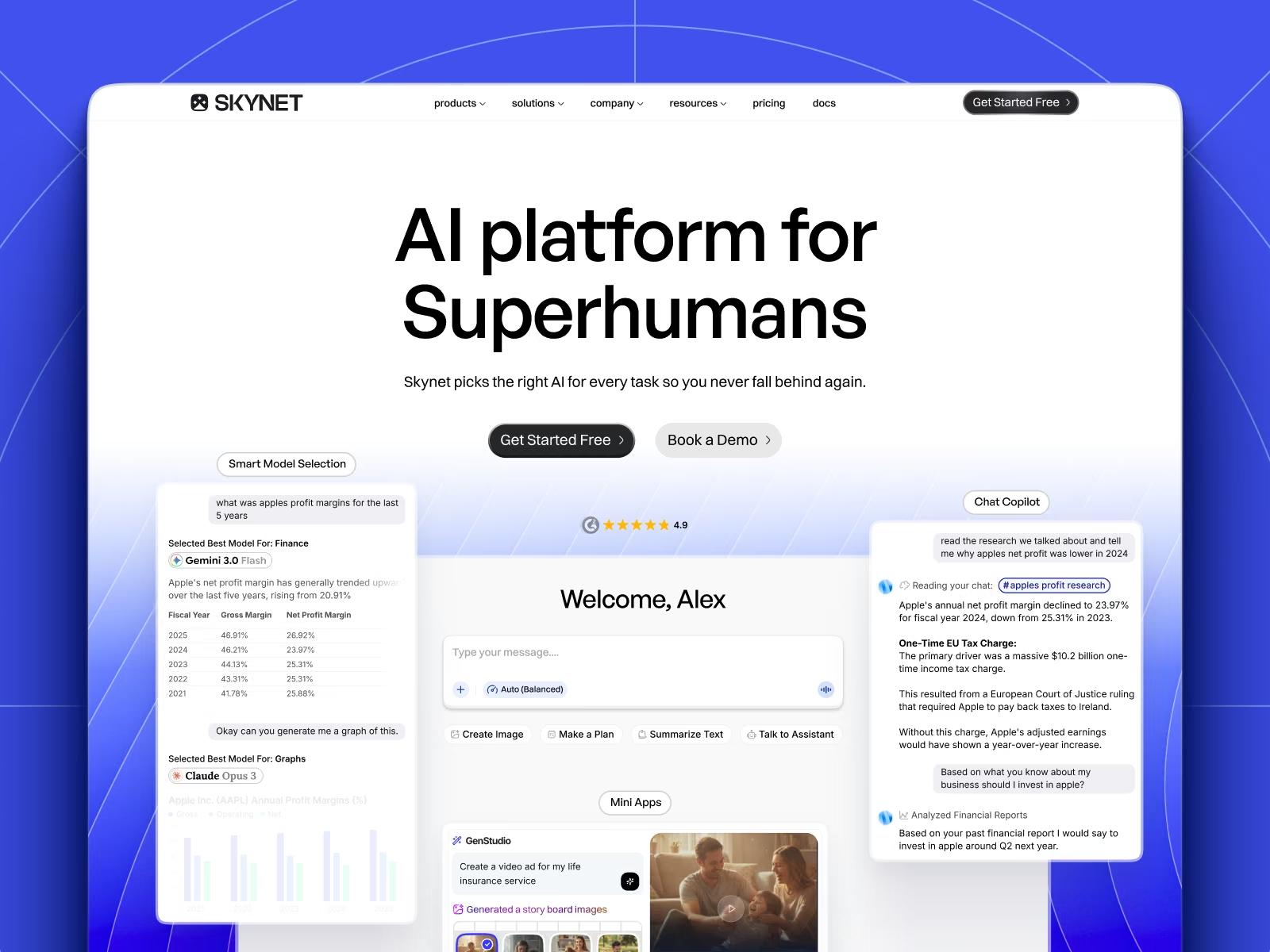
Skynet picks the right AI for every task. We built the brand, the marketing site, and the product design system that made that legible in a headline and true in the interface.
Brand identity, Marketing site, Product design, Design system
The problem
Skynet's technology was strong and completely invisible. The product picks the best model for each request across more than twenty providers, which is valuable and impossible to see. Early messaging led with the capability — model routing, provider coverage, benchmark comparisons — and prospects kept asking what it was for.
The second problem was surface area. A chat product, a copilot, mini-apps, and a template gallery all needed to feel like one thing, built by a team a fraction of the size of the competitors they were being compared against.
What we did
Brand
An identity designed to be applied by a small team at speed: a compact type and colour system, a mark that reads at 24px, and guidelines short enough that people actually follow them. In a category full of gradient meshes and purple glow, the credible move was to look like infrastructure.
Marketing site
Built as a section system rather than a set of page designs. Heroes, feature blocks, proof, pricing, and FAQ sections compose into any page — which is what let the team ship products, solutions, use-case, and template pages without design involvement in each one.
Product design system
Forty-plus components shared between Figma and code with matching names, covering chat, copilot, mini-apps, and the template gallery. New surfaces became assembly rather than design projects.
The decision that mattered most
Building the site as a content system rather than a set of pages. Six months later the team had published dozens of pages across seven collections — none of which needed a designer, because the sections already existed.
That choice is why the traffic curve moved. Publishing volume, not a redesign, is what took the site from tens of visitors a week to thousands.
The outcome
One brand across four product surfaces, a site the marketing team extends without design support, and a component library that made shipping a new product area a matter of weeks rather than quarters.
The clearest signal came later: the team kept publishing. A design system's real test is whether the people who inherit it still use it a year on, and this one is still the thing new pages get built from.
Want results like these?
Tell us what you're building. We'll show you exactly how we'd approach it — no pitch deck, no retainer negotiation.