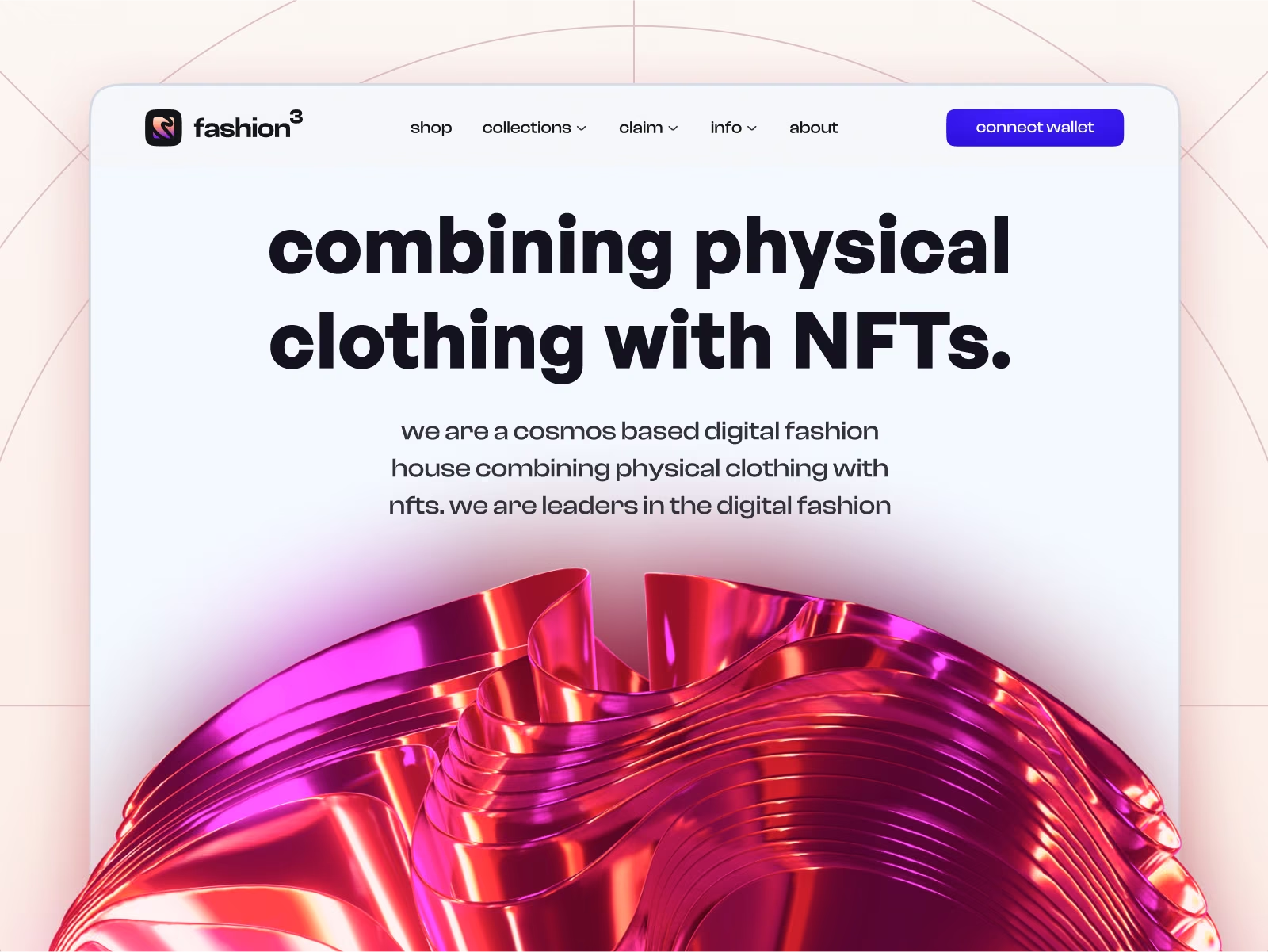
Clothing that exists in both worlds — a garment you wear and an asset you hold. The brand had to earn credibility with fashion buyers and crypto natives at the same time.
Brand identity, Website design, E-commerce design, Web development
The problem
Fashion³ sits on a line most brands fall off. Lean too crypto and fashion buyers see a token project with t-shirts attached. Lean too fashion and the on-chain mechanics — staking, $FSHN, proof of fashion — look like an afterthought bolted onto a shop.
There was also a straightforward explanation problem. A customer buys one thing and receives two: a garment that ships, and an NFT that unlocks rewards and works as a 3D asset. Nothing in either category's conventions covers that.
What we did
Built a fashion brand first
Editorial layouts, generous whitespace, product photography treated as the hero. The Web3 mechanics are explained in the brand's voice rather than allowed to set it — the site reads as a fashion house that happens to be on-chain.
Made 'phygital' concrete
Every collection shows both halves of what you're buying — the physical garment and the digital wearable — so the concept is demonstrated by the product page instead of defined in a paragraph.
Explained the rewards without the whitepaper
Staking, $FSHN earnings, and proof of fashion presented as membership benefits: what you get, what you have to do, what it's worth. The mechanism sits below that, for anyone who wants it.
The outcome
A brand that survives being seen by both audiences, a collection experience that sells the physical and digital halves together, and a shop that extends to new drops without a redesign each time.
Built with
Cosmos SDK
IPFS
Three.js
Want results like these?
Tell us what you're building. We'll show you exactly how we'd approach it — no pitch deck, no retainer negotiation.